
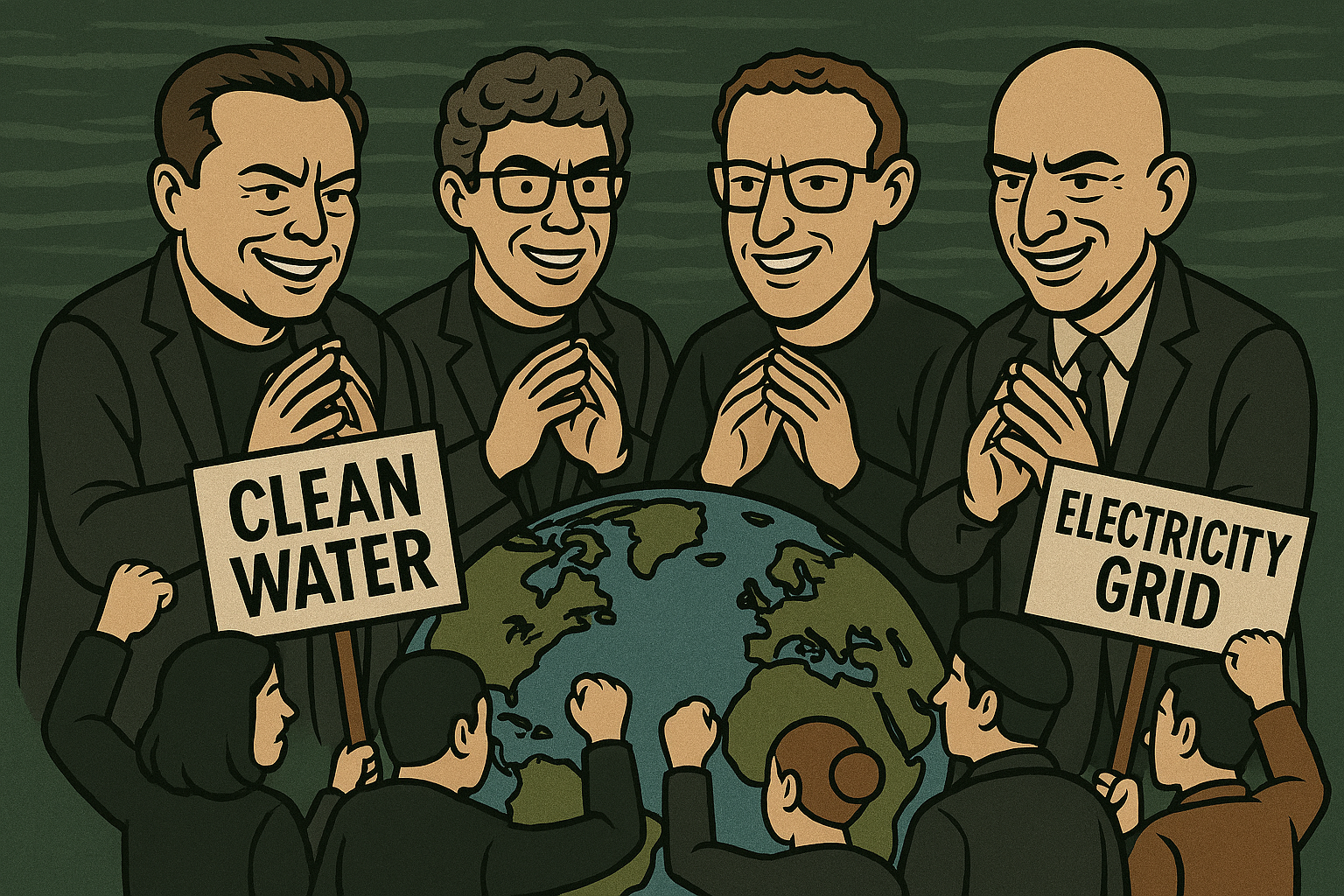
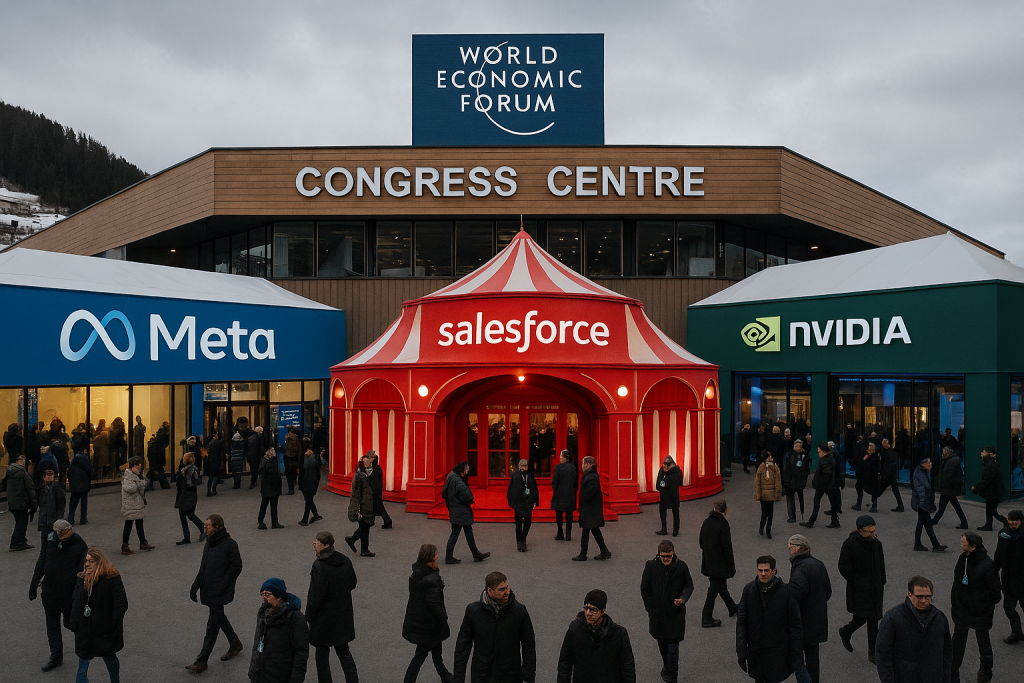
The Swiss Alps used to be the place where world leaders pretended to solve global crises over canapés. This year, Davos didn’t even bother with the pretense. The promenade—once a parade of climate NGOs and global‑control think tanks—was swallowed whole by tech giants staging what looked less like a global forum and more like a CES for CEOs. Meta and Salesforce took over storefronts. The USA House—sponsored by McKinsey and Microsoft—loomed like a corporate embassy. Climate panels played to half‑empty rooms while AI executives drew crowds like prophets unveiling a new religion.
If you didn’t know better, you’d think Nvidia had rented the Alps for a product launch.
This was the year Davos became a tech‑bro confessional, where the world’s most powerful AI executives aired their ambitions, anxieties, and thinly veiled turf wars. And beneath the polished optimism, the message was unmistakable: AI is no longer a technology story—it’s an infrastructure story, a geopolitical story, and increasingly, a story about who gets to rewrite the rules of the global economy.
Below is the full breakdown—quotes, receipts, and all.
Davos as a Tech Expo, Not a Global Forum
The optics said everything. As TechCrunch reporters noted, “some of the biggest storefronts have been converted and taken over by companies like Meta and Salesforce… and the largest was the USA House, sponsored by McKinsey and Microsoft.”
Meanwhile, panels on climate change and poverty “weren’t really attracting the crowds.”
The crowd had migrated to the AI temples—rooms packed with Jensen Huang, Satya Nadella, Demis Hassabis, Dario Amodei, and Elon Musk. The world’s problems were still on the agenda, technically. They just weren’t the main attraction.
“Welcome to Davos 2026, where global inequality takes a backseat to GPU scarcity, and the only melting ice anyone cares about is the coolant in a data center.”
So who’s driving the Davos tech script
| Player / Org | Role at Davos | Core Message on AI | Quiet Subtext / Concern |
|---|---|---|---|
| Satya Nadella (Microsoft) | Flagship incumbent cloud+AI | AI must reshape real-world work or it’s a bubble | Massive capex only justified if productivity shows up outside Big Tech; otherwise political blowback and investor fatigue |
| Jensen Huang (Nvidia) | AI infrastructure kingmaker | “Largest infrastructure build‑out in human history” | Needs the bubble to stay “rational”; power, chips, and data centers become geopolitical choke points |
| Demis Hassabis (Google DeepMind) | Frontier model R&D | Investment boom is outrunning deployment, even with real demand | Google wants to be seen as sober steward, not hype engine, while still justifying spend |
| Dario Amodei (Anthropic) | Safety‑branded lab | Advanced AI chips are “strategic national assets” | Pushes securitization of compute—tilts rules toward incumbents with access to state‑blessed hardware |
| OpenAI (Altman / Chris Lehane) | Consumer AI brand | Pivot from “AGI soon” to ads, hardware device, “last resort” monetization | Revenue strain, platform risk vs. Apple/Google/Microsoft; hardware is a control grab over the interface |
| Elon Musk (Tesla/xAI) | Wildcard billionaire | Showed up, light on substance, heavy on presence | Brand maintenance; keeps a seat at the AI table while attacking rivals elsewhere |
| Meta, Salesforce, Tata, US “House” (McKinsey+Microsoft) | Promenade occupiers | Turned Davos into a de facto tech expo | Visual proof that “global problems” are now a backdrop to AI sales pitches |
| Investors / BlackRock / macro voices | Capital allocators | “Rational bubble”: there is a bubble, but it’s justified by something “real” in AI | They’re betting they can exit before the crash while regulators and workers absorb the downside |
The “Not a Bubble” Bubble
If there was a single theme uniting the tech bloc, it was the insistence that this is not a bubble—or at least, not the bad kind.
Jensen Huang: Infrastructure, Not Hype
Nvidia’s CEO framed AI as the next industrial revolution, telling Euronews that Europe should “get in early now” and that robotics is a “once in [a] lifetime op.” He emphasized that AI’s constraints aren’t algorithms but “energy, land power and trade skill workers.”
This wasn’t hype, he insisted—it was infrastructure.
Our take, “Infrastructure” is doing a lot of work here—it recasts speculative capex as inevitable public good, while no one at Davos is on the hook for stranded data centers, grid strain, or local environmental costs.
Satya Nadella: If AI Doesn’t Change Real Work, It’s a Bubble
Nadella delivered the closest thing to a warning label: If all the upside sits on tech balance sheets and never shows up in broader productivity, that’s your bubble tell.
“A telltale sign of if it’s a bubble, would be if all we are talking about are the tech firms… then it’s just purely supply side.”
Translation: If AI doesn’t show up in real productivity, the whole thing collapses under its own GPU‑powered weight.
Executives say we’re past the FOMO phase; 2026 is about selective, process‑level deployment, not just slapping chatbots on everything. The same leaders warning about a bubble are the ones racing to lock in long‑term AI spend from enterprises and governments. so “prudence” doubles as a sales pitch for more “serious” (read: larger, stickier) contracts.
Demis Hassabis: Investment Is Outrunning Deployment
Google DeepMind’s CEO cautioned that parts of the investment boom are “outpacing real‑world deployment,” even though demand is strong.
When the people building the models start sounding like the adults in the room, you know the hype curve is bending into dangerous territory.
Productivity as Fig Leaf
The CEOs insisted that AI will transform work—eventually. But the cracks in the narrative showed.
The Enterprise Pivot: From FOMO to “Pragmatism”
Tencent Cloud’s Dowson Tong told CNBC:
“They’ve gone past the phase of FOMO… today, many of our customers are a lot more specific.”
So, when Tencent Cloud’s Dowson Tong said companies have “gone past the phase of FOMO,” (Fear Of Missing Out) He meant the stampede phase is over, and enterprises are finally asking what AI is actually for.
EY’s Raj Sharma added:
“Businesses will need to reimagine whole processes… that’s when you will start seeing the value.”
Translation: The easy wins are gone. Now comes the expensive, messy part. executives were basically admitting:
Vendors were selling pilots to soothe that fear rather than deliver real value.
Early AI adoption was driven by panic, not strategy.
Boards were saying “we need AI” without knowing why.
Companies act out of anxiety that they’ll fall behind competitors if they don’t jump in immediately.
The Workforce Reality Check
If AI is the new electricity, then the interface is the new power outlet.
“Control the interface, control the user”
- OpenAI hardware push: Plans for a dedicated AI device in 2026—moving beyond being just an app inside Apple/Google/Microsoft ecosystems.
- Davos vibe: Promenade takeovers by Meta, Salesforce, and the USA House (McKinsey+Microsoft) turn the town into a showroom for who owns the front door to users and enterprises.
Whoever owns the interface owns the data exhaust, the default assistant, and the ability to quietly upsell surveillance‑adjacent features under the banner of “productivity.”
“In the future, your AI assistant won’t just answer your questions—it’ll decide which questions you’re allowed to ask.”
While CEOs talked up productivity, others were blunter. Verizon CEO Dan Schulman warned: “We could see 20% to 30% unemployment levels over the next two to five years.”
IBM’s Arvind Krishna admitted: “There will probably be about 10% displacement.”
TIME’s panelists echoed the tension. NTT Data’s Abhijit Dubey warned of a “paradox of massive abundance [and] massive labor dislocation.”
“Agentic AI” and “physical AI” as the next hype ladder
- Agentic AI: Buzzword of the year—systems that act on your behalf, not just answer questions. Executives pitch it as the next revenue wave once chatbots plateau.
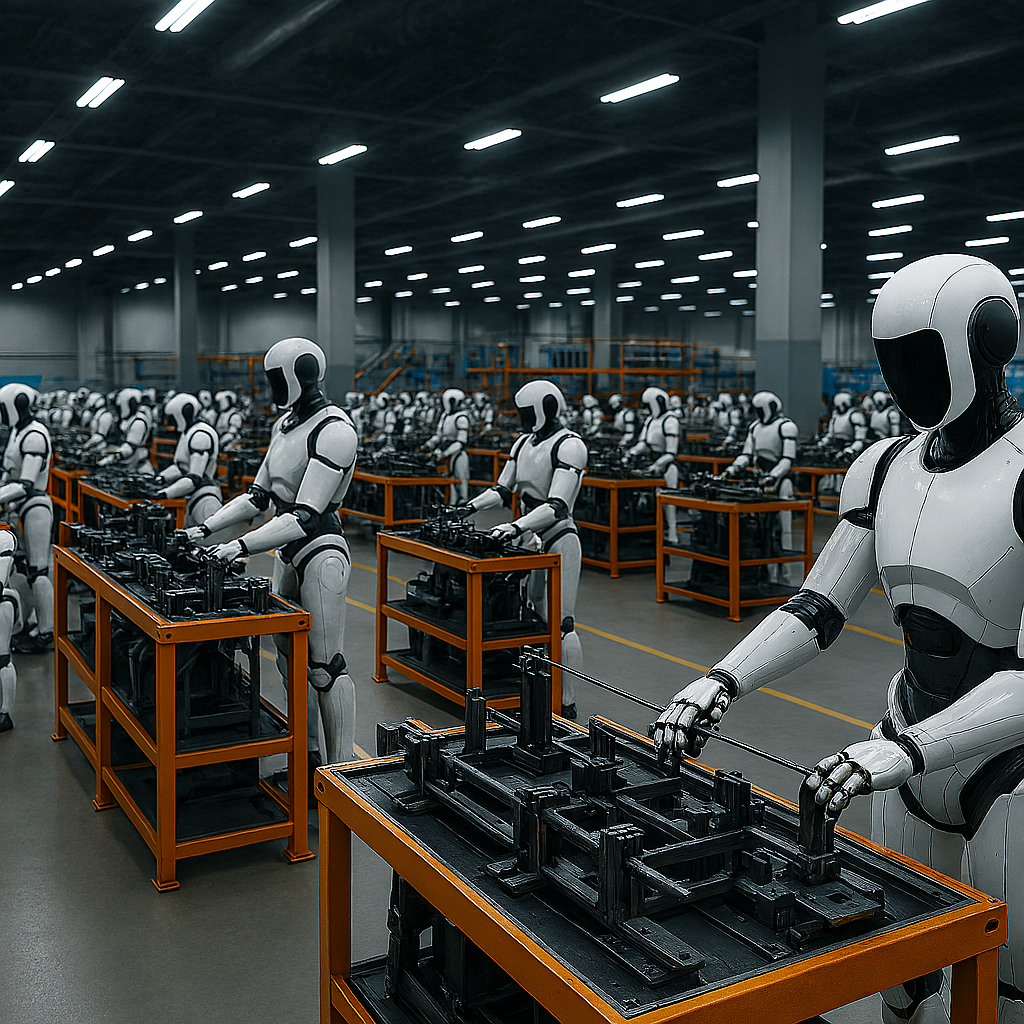
- Physical AI: Robots, embodied systems, and “AI in the real world” become the narrative bridge from software hype to factories, logistics, and cities.
Risk: The more autonomy they promise, the more they’ll argue for looser upfront constraints (“we can’t regulate what we haven’t fully explored yet”)—while externalizing safety, labor, and liability questions onto regulators who are always a step behind.
Geopolitics, Chips, and the Securitized Stack
This was the year AI became openly geopolitical.
“AI as geopolitics: chips, power, and national assets”
- Anthropic’s line: High‑end AI chips should be treated as strategic national assets, tightening the link between AI labs, chipmakers, and state power.
- Nvidia’s framing: Constraints aren’t algorithms but power, compute, skilled labor, and industrial capacity—exactly the levers states can subsidize or weaponize.
Implication: The more AI is cast as national security infrastructure, the easier it becomes to justify export controls, surveillance‑heavy deployments, and public subsidies that primarily entrench the current winners.
Dario Amodei’s Nuclear Comparison
Anthropic’s CEO detonated the biggest moment of the week when he compared selling Nvidia chips to China to:
“Like selling nuclear weapons to North Korea.”
He warned that advanced AI models could be “100 million people smarter than any Nobel Prize winner,” and that giving China the compute to build them could “fundamentally shift global power dynamics.”
This wasn’t a private briefing. This was on stage, in public, directed at a company that invested $10 billion in Anthropic.
Nvidia’s Counter‑Frame: Power, Land, Labor
Huang’s message was clear: the bottleneck isn’t the model—it’s the grid. AI needs “more energy, more land power and more trade skill workers.”
Nadella: Infrastructure Is Government‑Driven
Nadella reminded the crowd that AI’s success depends on public infrastructure:
“Electrical grids are fundamentally driven by governments.”
When trillion‑dollar companies start calling chips “strategic national assets,” they’re not just forecasting the future—they’re lobbying for it.
Elon Musk’s Davos Debut: Utopia, Deadlines, and a Factory Full of Robots
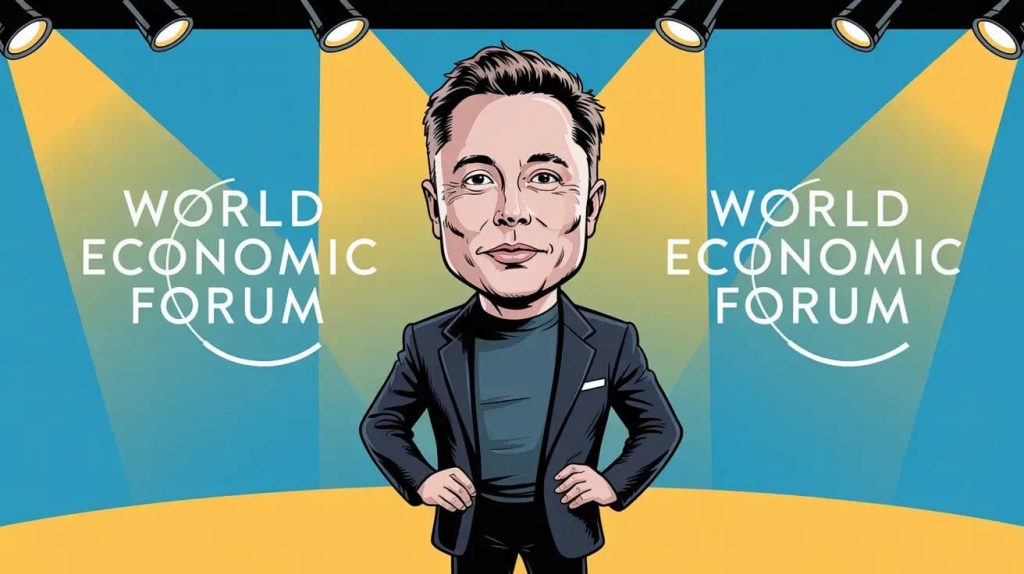
Elon Musk arrived at Davos like a man stepping onto a stage he’d been avoiding for years. It was his first appearance at the World Economic Forum, and he used it to sketch a future where humanoid robots outnumber humans, factories hum along with minimal human presence, and aging itself becomes “a very solvable problem.”
It was classic Musk: sweeping timelines, cosmic ambition, and a delivery that oscillated between TED Talk futurism and late‑night alien‑confession humor.
Robots Will “Saturate All Human Needs”
Musk told the audience that by the end of the decade, humanoid robots would be so abundant they would “saturate all human needs.” Optimus, Tesla’s humanoid robot, is already performing basic tasks in Tesla factories, and Musk claimed it will handle complex industrial work within a year.
Then came the kicker:
Tesla will begin selling Optimus robots to the public by the end of 2027, Musk said.
Not to enterprises. Not to governments. To the public.
AI Will Outthink Humanity — Individually by 2026, Collectively by 2030
Musk’s timeline for AI intelligence was even more aggressive:
- Smarter than any individual human by late 2026
- Smarter than all humans combined by 2030–2031
This wasn’t framed as a warning. It was framed as inevitability — and opportunity.
Aging? “A Very Solvable Problem.”
In a moment that felt ripped from a Silicon Valley writer’s room, Musk tossed in that aging itself is “a very solvable problem.” No elaboration. No ethical framing. Just a casual aside, as if he were discussing battery range.
The Muskian Cocktail: Jokes, Geopolitics, and Grandiosity
He sprinkled in jokes about being an alien and riffed on Trump’s supposed interest in “a little piece of Greenland, a little piece of Venezuela.” It was part performance, part prophecy — and part provocation.
What’s Missing: The Human Question?
For all the talk of abundance, intelligence explosions, and ageless humans, Musk didn’t address the one question that hung over the room:
What do humans actually do in a world where robots handle everything?
If Optimus becomes a household appliance, if factories run themselves, if AI surpasses collective human intelligence, and if aging is optional — then what becomes of:
- work
- purpose
- income
- social structure
- political legitimacy
Musk didn’t say. He rarely does.
Musk’s Davos appearance wasn’t just a product pitch. It was a worldview pitch — one where:
- labor is optional
- scarcity is obsolete
- robots are citizens of the economy
- and humanity’s role is… to be determined
It’s a seductive vision, but also a vacuum. A future where abundance solves everything — except the meaning of being human.
“In Musk’s Davos future, the robots do the work, the humans live forever, and the only thing left to automate is the economy itself. At that point, the Optimus units may as well run Davos too — they’ll certainly have the attendance numbers.”
The Missing Stakeholders
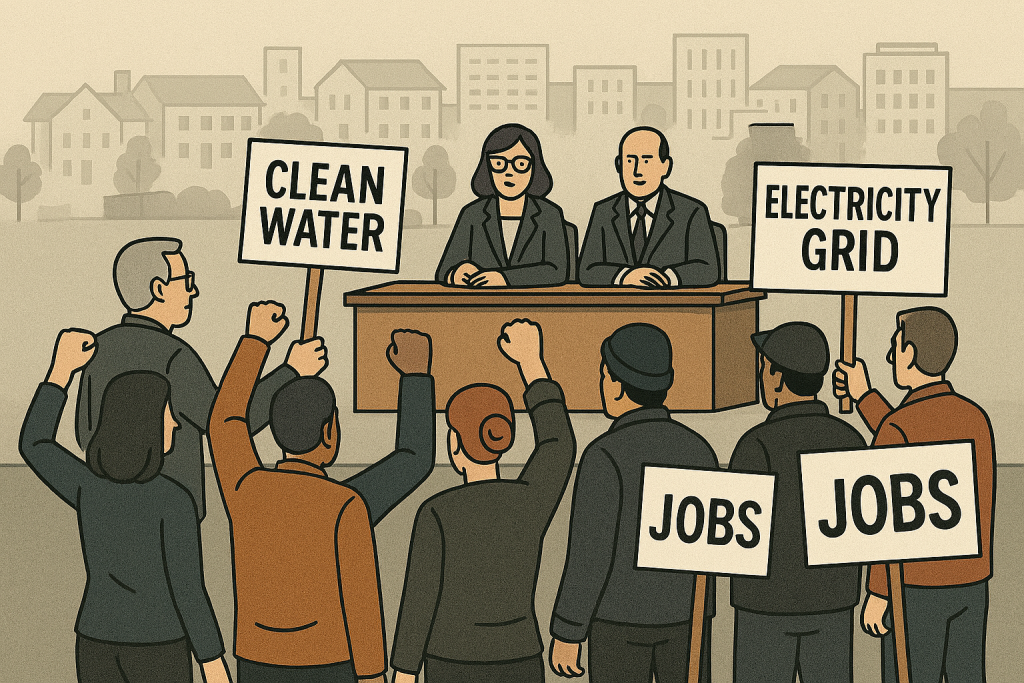
While CEOs debated compute, power grids, and geopolitical strategy, the people most affected by AI were largely absent.
Workers
TIME’s panelists warned of “job impacts” and the need to shift workers “from doers of tasks to directors of systems.”
But as Schulman asked: “To what will you reskill?”
Young Workers
Stanford’s Erik Brynjolfsson reported that people aged 22–25 in AI‑exposed occupations already saw 16% employment declines.
Communities Hosting Data Centers
No one on stage talked about:
- water usage
- land use
- grid strain
- environmental externalities
But they did talk about “more energy” and “more land power.” Just not who pays for it.
Panels on global poverty and climate change were overshadowed by AI showrooms.
The people who will live with the consequences weren’t in the room. The people who will profit from them were.
Words They Used vs. What They Really Mean
| Word/Phrase | Literal Meaning | Actual Meaning at Davos |
|---|---|---|
| “Infrastructure” | Data centers, chips, power | Public subsidies, regulatory insulation, and geopolitical leverage |
| “Productivity” | Doing more with less | Doing the same with fewer humans |
| “Agentic AI” | Autonomous task‑performing systems | Replace middle managers without saying it out loud |
| “Leapfrog” | Europe’s chance to catch up | Build factories for Nvidia |
| “Pragmatic adoption” | Careful enterprise rollout | We need bigger contracts to justify capex |
| “Strategic national asset” | Important resource | Government‑protected monopoly |
The Boast‑and‑Bicker Era
TechCrunch captured the vibe perfectly:
“CEOs laying a vision… while also acknowledging ongoing concerns that they’re inflating a massive bubble… and taking swipes at their competitors.”
This wasn’t corporate diplomacy. It was a public turf war.
- Anthropic vs. Nvidia over chips
- Microsoft vs. Google over productivity narratives
- OpenAI vs. everyone over interface control
- Musk vs. the room by simply showing up
The gloves came off. The stakes were clear.
The Final Nuts — The Subscription Plan for Reality
Davos 2026 will be remembered as the moment the tech industry stopped pretending AI was just another tool. They framed it as infrastructure, geopolitics, labor policy, and national security—all rolled into one. And they did it while occupying the physical and narrative space once reserved for global crises.
The message was unmistakable: AI isn’t just shaping the future—it’s claiming it.
What got sidelined or hollowed out
- Climate, poverty, global risk panels were visibly out‑drawn by AI storefronts and CEO stages; the promenade optics say more than the official agenda.
- Public interest framing was mostly reduced to “productivity” and “growth,” with little concrete talk about labor displacement, public opinion, surveillance creep, or democratic oversight of AI infrastructure.
- Competition concerns surfaced only as snarky jabs between CEOs—“boast and bicker” more than serious antitrust or concentration debate.
And here’s the other part they didn’t say out loud:
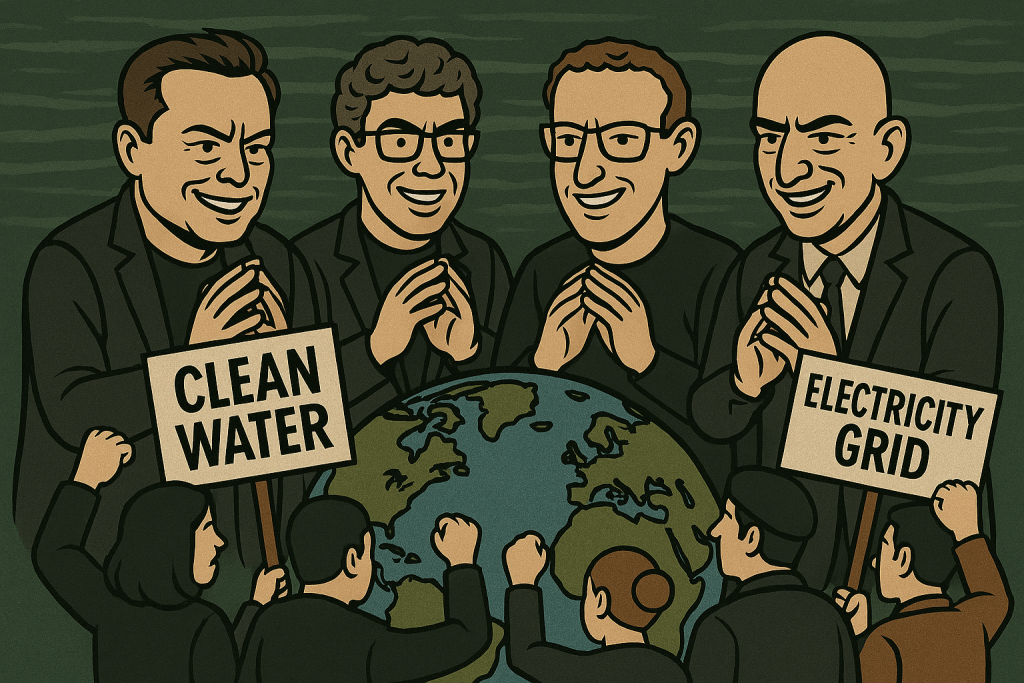
The more AI becomes “infrastructure,” the more the public will be asked to subsidize it, regulate it, and live with its consequences—while the benefits remain concentrated in the same handful of firms that took over the Davos promenade.
So yes, they call it a “rational bubble.” But from everywhere outside the Alpine bubble, it looks more like a subscription plan for reality—auto‑renew enabled, cancellation button hidden behind three AI assistants and a nondisclosure agreement.
Who’s Really in Control When AI Takes Over — the Machines or the Tech Bros?
The real plot twist in the “AI takes over the world” narrative isn’t a rogue machine uprising — it’s the far more mundane possibility that a handful of tech billionaires become the de‑facto operating system for human society.
The machines won’t seize power; the people who own the machines will. When CEOs talk about “agentic AI,” or “robot abundance,” and systems that surpass human intelligence, they’re not describing a loss of control — they’re describing a transfer of control, from democratic institutions to private labs, from public oversight to corporate roadmaps, from collective decision‑making to the whims of founders who think in timelines, not consequences.
If AI becomes the infrastructure of everything — labor, communication, governance, even meaning — then the real question isn’t whether machines will dominate us. It’s whether the future ends up ruled by algorithms… or by the men who write their release notes.
Any questions or concerns can be commented below or Contact Us here.


🧠 Core Reporting and Quotes
- TechCrunch – Davos 2024: AI CEOs, storefronts, and bubble talk
https://techcrunch.com/2024/01/18/davos-2024-ai-ceos-and-the-rational-bubble - CNBC – Elon Musk’s Davos debut and AI predictions
https://www.cnbc.com/2024/01/18/elon-musk-davos-2024-ai-robots-optimus.html - TIME – Davos 2024: AI, labor, and global risk panels
https://time.com/6554321/davos-2024-ai-labor-displacement - Euronews – Jensen Huang on robotics and Europe’s AI future
https://www.euronews.com/next/2024/01/17/nvidia-ceo-jensen-huang-davos-robotics-europe - Reuters – Anthropic CEO compares AI chips to nuclear weapons
https://www.reuters.com/technology/anthropic-ceo-ai-chips-nuclear-weapons-davos-2024-01-18 - World Economic Forum – Official Davos 2024 agenda and speaker list
https://www.weforum.org/events/world-economic-forum-annual-meeting-2024
🧾 Supporting Commentary and Analysis
- MIT Technology Review – Agentic AI and deployment gaps
https://www.technologyreview.com/2024/01/19/agentic-ai-davos-deployment - Bloomberg – Nadella’s productivity warning and enterprise AI shift
https://www.bloomberg.com/news/articles/2024-01-18/nadella-ai-productivity-davos - Fortune – OpenAI’s hardware ambitions and interface control
https://fortune.com/2024/01/17/openai-hardware-device-davos - The Guardian – Davos optics and civil society absence
https://www.theguardian.com/world/2024/jan/18/davos-2024-tech-takeover
- Deeznuts.tech Developer Progress Update 8-17-2026
- The Truth Behind the U.S. Government’s Sudden Shift on Anthropic
- Google Gives in to Uncle Sam’s Demands
- China Breaks the Brain Barrier with Neuracle BCI Technology
- ⚖️ The Supreme Court Just Blinked — And Left AI Copyright Law in a Legal No‑Man’s‑Land

Leave a Reply