

How Beijing’s unified techno‑industrial machine just leapfrogged the West in invasive neurotech — and why it matters far beyond medicine: China’s National Medical Products Administration (NMPA) has officially approved the world’s first invasive brain‑computer interface (BCI) for commercial medical use, developed by Shanghai‑based Neuracle Medical Technology. This puts China ahead of Neuralink, Synchron, and every Western rival — not in a lab demo, not in a clinical trial, but in real-world, marketable medical deployment.
🧠 The Breakthrough That Rewrites the BCI Timeline
China has officially approved the world’s first invasive brain‑computer interface (BCI) for commercial medical use, developed by Shanghai‑based Neuracle Medical Technology.
This isn’t a lab demo, a flashy livestream, or a “look, it moved!” proof‑of‑concept. This is regulatory clearance for real‑world deployment — hospitals can buy it, surgeons can implant it, and patients can use it.
The system pairs:
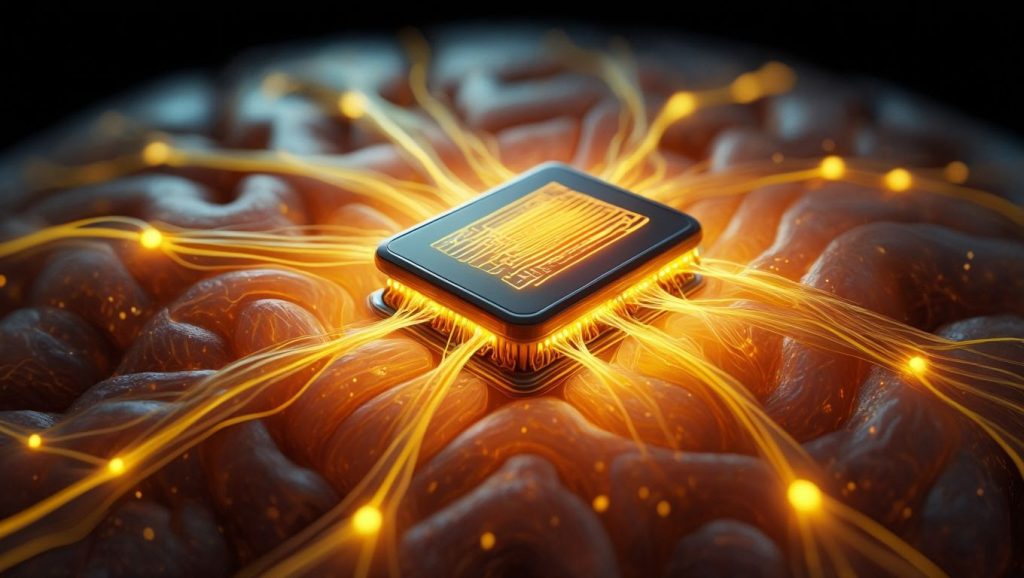
- A coin‑sized wireless neural implant placed on the dura (not penetrating the cortex)
- A robotic/pneumatic glove
- A decoding system that turns motor‑intention signals into grip and hold actions
It’s designed for 18–60‑year‑olds with upper‑limb paralysis who can move their arms but cannot grasp — a narrow but high‑impact clinical niche.
China’s National Medical Products Administration (NMPA) has granted marketing approval to Neuracle Medical Technology’s implantable brain–computer interface hand motor function compensation system, making it the first invasive BCI cleared for commercial medical use anywhere in the world.
The system—often referred to as the NEO system—targets adults with upper‑limb paralysis from cervical spinal cord injury, who retain some arm movement but cannot grasp. It uses epidural (on‑dura) electrodes and a pneumatic/robotic glove to restore limited hand grasp via decoded neural signals.
While Neuralink and Synchron remain in trial mode, China just crossed the commercialization line first.
🔍 What the Device Actually Does
A targeted neuro‑rehabilitation system
- Restores limited hand function for spinal cord injury patients
- Uses epidural electrodes to reduce surgical risk
- Decodes neural signals into functional grasping
- Demonstrated real patients picking up objects in trials
What we know about the device and method
Regulatory classification: Approved as a Class III medical device—China’s highest risk category—allowing clinical use and commercial distribution in hospitals.
Implant location and design: Coin‑sized wireless implant placed on the dura mater, not penetrating brain tissue, to reduce direct cortical damage risk while still capturing motor‑related signals.
System components: Implanted EEG‑like electrode array + external decoder + pneumatic/robotic glove that executes grasping motions based on the user’s intended movement.
Indication and population: Adults (roughly 18–60) with stable tetraplegia/upper‑limb paralysis after cervical spinal cord injury; not a general‑purpose BCI, but a narrow neuro‑rehab indication.
This isn’t sci‑fi telepathy or general‑purpose mind‑control. It’s a specific, clinically grounded assistive technology — and that’s exactly why it got approved.
📊 What We Know About Trials, Safety, and Evidence
China has released high‑level success narratives, but not the granular, peer‑reviewed data you’d expect from Western regulators.
Evidence base: trials, safety, and effectiveness
Public reporting so far gives headline outcomes but limited granular data (e.g., no full peer‑reviewed trial dossier yet). What’s visible:
So far, no public reporting of failed trials, device explants, or major complications. Given China’s media environment and the strategic framing of BCI as a “future industry,” it’s reasonable to assume selective disclosure—we’re seeing success narratives, not full registries of all outcomes.
Clinical trial outcomes (high‑level):
NMPA and multiple outlets report that in clinical trials, patients regained the ability to grab and hold objects using the system.
Sixth Tone notes that trials showed restoration of limited hand movement, not full functional recovery—so we’re talking partial, task‑specific improvement.
Sample size and design:
None of the English‑language reports provide detailed sample size, control group design, follow‑up duration, or statistical endpoints. Most refer generically to “clinical trials” or “clinical studies” without a published protocol.
Xinhua and CGTN emphasize successful cases (e.g., patients playing games or grasping objects after implantation) but again without full trial metrics.
Safety profile (reported):
Reports describe the implant as “minimally invasive” epidural rather than penetrating, implying lower risk of hemorrhage and tissue damage compared with deep cortical arrays.
No serious adverse events are highlighted in official or media summaries; the absence of mention is not equivalent to proof of zero serious events, just that they’re not foregrounded.
Negative or mixed results:
So far, no public reporting of failed trials, device explants, or major complications. Given China’s media environment and the strategic framing of BCI as a “future industry,” it’s reasonable to assume selective disclosure—we’re seeing success narratives, not full registries of all outcomes. So, in summary we have regulatory approval + positive case reports + high‑level trial claims, but not yet the kind of detailed, peer‑reviewed safety/efficacy data you’d expect from, say, an FDA PMA dossier.
Reported positives
- Patients regained basic grasping ability
- No publicly reported serious adverse events
- Implant avoids penetrating brain tissue, reducing risk
What’s missing
- Full trial protocols
- Sample sizes
- Long‑term follow‑up
- Adverse event registries
- Device longevity data
China’s media environment tends to highlight successes, not failures — so absence of negative results doesn’t mean absence of risk.

🏁 How Neuracle Leapfrogged Neuralink and Synchron
Neuracle (China)
- Commercial approval granted
- Narrow, high‑value indication
- Epidural approach reduces risk
- Backed by national “future industry” strategy
Neuralink (U.S.)
- Early human trials only
- Demonstrated cursor control and gaming
- No commercial approval
- Musk claims “high‑volume production” is coming
Synchron (U.S./Australia)
- Stentrode delivered via blood vessels
- Still investigational
- No commercial approval
China’s advantage isn’t necessarily superior tech — it’s superior regulatory velocity.
🏆 Why China Got There First
1. BCI is a national strategic priority
Beijing explicitly labels BCI as a “future industry”, placing it alongside AI, quantum, and robotics.
2. A unified techno‑industrial pipeline
China’s state, industry, and research institutions operate with aligned incentives: Deploy first, iterate fast, scale aggressively.
3. Faster regulatory pathways
The NMPA moves quicker than the FDA, especially on frontier tech where China wants global leadership.
4. A massive domestic patient population
Millions of spinal cord injury patients create a large, immediate clinical market.
Pros: why this is a real milestone
Ecosystem acceleration and standard‑setting China is using this as a signal: BCI is part of its national “future industries” portfolio, with new research centers and funding pipelines announced alongside the approval. That can accelerate tooling, surgical expertise, and data accumulation faster than in more cautious regimes.
Concrete functional gains for a hard‑to‑treat population Spinal cord injury hand function is a brutal unmet need; China alone has an estimated millions of patients, with ~3.7 million cited in some coverage. Even partial grasp restoration can radically change independence and quality of life.
Epidural approach as a risk‑moderation strategy By staying on the dura, Neuracle avoids some of the highest‑risk aspects of penetrating microelectrode arrays (bleeding, scarring in cortex), while still enabling useful decoding—arguably a pragmatic middle ground between non‑invasive EEG and fully penetrating arrays.
First real‑world commercialization of invasive BCI This moves BCI from “hero demo” (Neuralink, Synchron, academic labs) to reimbursable clinical tool in at least one jurisdiction. That’s a category shift: hospitals can now buy and deploy an invasive BCI as a standard device.

🌍 Why This Moment Matters Globally
This isn’t just a medical milestone — it’s a geopolitical signal.
China is telling the world:
“We will commercialize frontier neurotechnology first — and we will learn faster because we deploy faster.”
Potential for political and commercial pressure BCI is explicitly framed as a strategic sector in China’s industrial policy. That raises the possibility that speed and symbolism (beating Neuralink, claiming “world first”) could bias regulatory posture toward approval with incomplete long‑term evidence.
Unknowns around durability and reliability Invasive BCIs face:
Signal degradation over time (gliosis, electrode encapsulation)
Hardware failure, infection risk, revision surgeries None of the current reports provide multi‑year performance data, so device longevity and maintenance burden are still question marks.
Data governance and patient autonomy There is no detailed public discussion yet of:
How neural data are stored, shared, or used for secondary purposes
Whether patients can opt out of data aggregation In a system where state and commercial interests are tightly coupled, neural data governance is a non‑trivial concern. (This is an inference based on China’s broader tech governance patterns, not something Neuracle has explicitly disclosed.)
Precedent for lowering global guardrails Once one major regulator approves an invasive BCI with limited public data, pressure mounts on others (FDA, EMA, etc.) to “keep up,” potentially nudging standards toward faster approvals with less long‑term evidence.
This approval:
- Shifts the center of gravity in neurotech
- Pressures U.S. regulators to accelerate
- Gives China a data advantage from real‑world use
- Sets a precedent for rapid deployment of embodied AI systems
- Reinforces China’s pattern: demo → scale → deployment
- Demonstrates China’s willingness to commercialize high‑risk frontier tech first, similar to its approach with gene editing, drones, and robotics.
- Creates a template for how embodied AI and neural interfaces may enter the market in non‑Western regulatory environments.
The U.S. invented much of the underlying science. China is commercializing it. This is the same pattern we saw with humanoid robotics: China moves from demo → scale → deployment faster than anyone expects.
⚖️ Pros and Cons of the Neuracle Breakthrough
Pros
- Real functional gains for paralyzed patients
- Lower‑risk epidural design
- First commercial pathway for invasive BCI
- Accelerates global neurotech competition
- Creates a template for future neuro‑rehab devices
Cons
- Limited transparency in trial data
- Unknown long‑term safety and durability
- Potential political pressure on regulators
- Neural data governance concerns
- Risk of global “race to the bottom” in safety standards
📚 Sources
- Bloomberg
- Fierce Biotech
- Sixth Tone
- Xinhua
- CGTN
- MassDevice
- China Tech Pulse
- Robot Today
- Yahoo
- Trial Medpath
These outlets provide the factual backbone for the approval, trials, and regulatory framing.

🥜 The Final Nut: America’s Red Tape vs. China’s Runway
Here’s the uncomfortable truth:
In the U.S., innovation moves at the speed of paperwork.
In China, it moves at the speed of strategy.
America’s regulatory system is a maze of gatekeepers — agencies, committees, advisory boards, political appointees, and industry lobbyists. Every step costs money. Every delay costs momentum. Every approval requires navigating a pay‑to‑play ecosystem where influence, lobbying, and compliance consulting become part of the development budget.
The FDA isn’t just a safety agency — it’s a bottleneck with a price tag.
Meanwhile, China’s system is:
- Unified
- Goal‑aligned
- Politically streamlined
- Economically incentivized
- Strategically coordinated
China’s approval of Neuracle’s BCI wasn’t slowed by:
- Competing regulatory fiefdoms
- Lobbying wars
- Election‑cycle politics
- Agency turf battles
- Endless rounds of “additional data requested”
Instead, it was driven by:
- National strategy
- Industrial policy
- Clinical need
- Technological ambition
And here’s the kicker:
By deploying first, China will learn first — and that feedback loop is how technological leads become technological monopolies.
Real‑world usage → faster iteration → better devices → more patients → more data → better algorithms → global leadership.
The U.S. invented the race. China is running it.
And unless America rethinks how it regulates frontier tech, Neuracle’s head start won’t be a one‑off — it’ll be the new normal.
Any questions or concerns, please comment below or Contact Us here.


- Deeznuts.tech Developer Progress Update 8-17-2026
- The Truth Behind the U.S. Government’s Sudden Shift on Anthropic
- Google Gives in to Uncle Sam’s Demands
- China Breaks the Brain Barrier with Neuracle BCI Technology
- ⚖️ The Supreme Court Just Blinked — And Left AI Copyright Law in a Legal No‑Man’s‑Land

Leave a Reply