
How the World Sleepwalked into Building Skynet
The image is almost too terminator on‑the‑face: the U.S. defense secretary standing inside SpaceX’s Starbase, framed by stainless‑steel rockets and the mythology of techno‑destiny, announcing that the Pentagon will become an “AI‑first” military. Not “AI‑enhanced.” Not “AI‑assisted.” AI‑first.
And then the kicker: Elon Musk’s Grok will be plugged into Pentagon networks—unclassified and classified—within weeks. Google’s systems too. Roughly three million personnel will soon operate inside a command structure where frontier chatbots sit in the same digital bloodstream as war plans, intelligence feeds, and operational data from two decades of conflict.
This wasn’t a tech demo. It was a cultural coup. A declaration that the center of gravity in U.S. defense has shifted from the Pentagon to the Valley, from generals to engineers, from doctrine to data. Bureaucracy is now framed as the enemy. Acceleration is the mission. And the line between civilian tech and military infrastructure is dissolving so fast it might as well have never existed.
We used to joke about Skynet. Now we’re onboarding it.
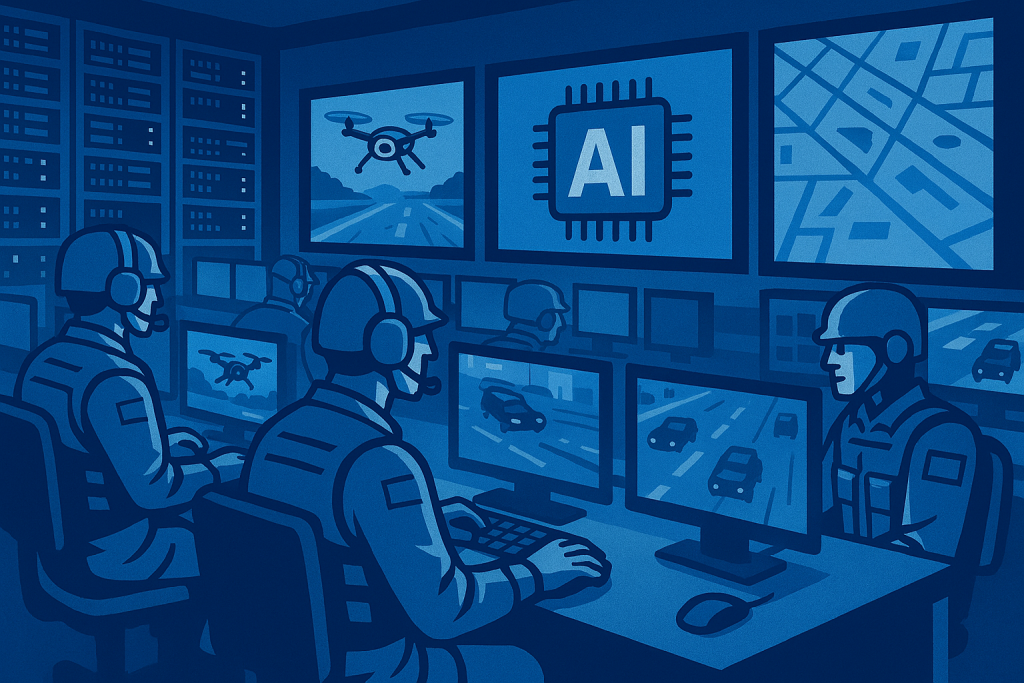
🚀 THE NEW DOCTRINE: INTEGRATE FIRST, ASK Questions Later
The Pentagon’s new strategy reads like a manifesto for a future where hesitation is treason. “Any lawful use” of AI is now the procurement standard. “Responsible AI” is demoted to a footnote. The priority is speed—deploying models inside real command structures, under pressure, at night, with consequences.
Gaza: The World’s First AI‑Driven Battlespace
If Starbase was the symbolic moment, Gaza is the operational one.
The world’s first large‑scale deployment of AI‑assisted targeting systems — Gospel and Lavender — has already happened there. These systems ingest:
- phone numbers
- addresses
- social media connections
- chat group memberships
- satellite imagery
- drone feeds
- pattern‑of‑life data
And they output kill lists.
Lavender reportedly flagged tens of thousands of individuals as targets, with human oversight reduced to seconds‑long rubber‑stamping. Critics questioned the legality, accuracy, and training data of these systems — but the deeper truth is this:
Gaza became the testing ground for automated war.
A live‑fire laboratory where:
- AI identifies targets
- drones confirm them
- automated systems track movement
- and human operators increasingly become supervisors, not decision‑makers
This is the template. This is the export model. This is the future every military is now racing toward.
This is the part the public hasn’t absorbed: Once a frontier model sits on a classified network, it stops being a consumer toy. It becomes part of the kill chain.
And the kill chain is being rebuilt around it.
One of the Pentagon’s “pace‑setting projects” is literally called Swarm Forge—a program to “iteratively discover, test, and scale” autonomous systems in combat. Another aims to deploy agentic AI for “battle management and decision support,” from campaign planning to target selection.
This is not science fiction. This is procurement.

🌐 THE GLOBAL CONVERGENCE: EVERYONE IS BUILDING THEIR OWN VERSION
The U.S. isn’t alone. That’s what makes this moment so volatile.
South Korea: The First Democracy to Publicly Pivot Toward an AI‑Powered Military
South Korea is not dabbling. It is restructuring its entire defense apparatus around AI.
A. AI for Command Decisions
The Ministry of Defense announced plans to build AI systems to assist commanders in combat decision‑making and defense policymaking.
This isn’t “AI for logistics.” This is AI for war decisions.
B. AI‑Driven Weapons Programs
South Korea’s Defense Acquisition Program Administration (DAPA) reorganized itself to explicitly institutionalize AI policy for weapons systems.
This includes:
- AI‑based manned‑unmanned teaming
- autonomous surface vessels (like the Tenebris USV)
- AI‑enhanced target detection
- battlefield awareness
- engagement decision‑making
This is one of the first times a democratic government has openly created a centralized AI weapons strategy office. South Korea is a U.S. ally. It’s a technologically advanced democracy. And it is now building the architecture for algorithmic warfare.
When democracies normalize this, the world follows.
Japan: The Quiet Giant Awakening
Japan’s recent announcements of a massive military buildup — its largest since WWII — include:
- long‑range strike capabilities
- drone swarms
- AI‑enhanced missile defense
- autonomous maritime systems
- expanded cyber and space command
Japan is not yet as explicit as South Korea about AI‑first doctrine, but the direction is unmistakable: AI is the backbone of its rearmament.
Combine this with Japan’s industrial capacity and demographic pressures, and you get a nation that will increasingly rely on automation to compensate for a shrinking population.
China
The PLA’s doctrine of “intelligentized warfare” is a full‑spectrum push to fuse AI into command, targeting, logistics, and wargaming. The December Pentagon report on PLA AI makes the subtext explicit: the U.S. is accelerating because China is accelerating, and China is accelerating because the U.S. is accelerating.
Arms races don’t need villains. They just need momentum.
Israel
Gaza has become the world’s most scrutinized live‑fire laboratory for algorithmic warfare—AI‑assisted targeting, pattern‑of‑life analysis, drone swarms, and population‑level surveillance. The systems tested there don’t stay there. They become exports, templates, and precedents.
Russia & Ukraine
Ukraine is the first major war where loitering munitions, autonomous navigation, and AI‑assisted ISR are not experiments—they’re routine. Once a technology proves itself in war, it spreads faster than any treaty can contain.
Mid‑Tier Powers
Turkey, Iran, the Gulf states, and others are building indigenous drone programs, importing AI targeting systems, and deploying “smart border” and protest‑control tech. Kazakhstan just launched a military AI unit to “digitize defense.”
You no longer need to be a superpower to field semi‑autonomous violence. You just need vendors.
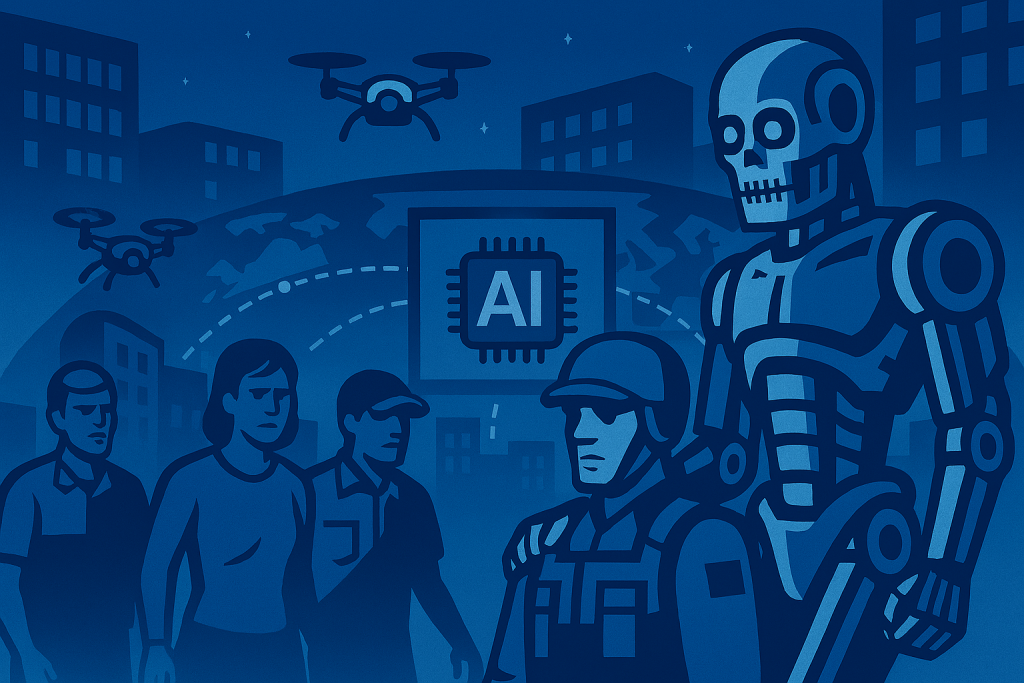
🎭 THE DOMESTIC FEEDBACK LOOP: THE BATTLEFIELD COMES HOME!
The same stack that runs autonomous targeting runs predictive policing. The same models that analyze insurgent networks analyze protest networks. The same drones that patrol borders patrol neighborhoods.
If Gaza is the testing ground, the United States is the proving ground.
For decades, U.S. police departments have imported Israeli‑developed surveillance systems, crowd‑control tactics, and urban‑warfare training. But the newest phase is more explicit: federal agencies adopting AI‑driven, IDF‑style tools and tactics for use on American soil.
The most recent flashpoint involves ICE, which has begun deploying technologies and operational methods that mirror the systems used in Gaza and the West Bank:
- AI‑assisted identity tracking
- real‑time pattern‑of‑life surveillance
- drone‑supported operations in urban neighborhoods
- militarized raids using tactics refined in conflict zones
These aren’t metaphors. They’re the same categories of tools — predictive analytics, biometric databases, drone reconnaissance, and algorithmic threat scoring — that have been field‑tested in occupied territories and then exported globally.
And now they’re being used in U.S. cities.
The Logic Is Simple — and Dangerous
Once a technology is normalized in war, it becomes “standard practice.” Once it becomes standard practice, it becomes “cost‑effective.” Once it becomes cost‑effective, it becomes “available for domestic use.”
The pipeline is seamless:
Gaza → U.S. border → American cities.
The same AI‑driven systems that map insurgent networks, can map immigrant communities. The same drones that track militants, can track protesters. The same predictive models that flag “high‑risk individuals” abroad, can flag “high‑risk neighborhoods” at home.
This is the part of the story most Americans don’t see: the militarization of domestic agencies is not a separate phenomenon — it is the domestic branch of the same AI‑warfare revolution.
The ICE Example Is the Canary in the Coal Mine
When a federal agency begins using:
- battlefield‑grade surveillance
- foreign‑developed targeting analytics
- militarized crowd‑control tactics
- AI‑enhanced operational planning
inside U.S. cities, it signals that the boundary between “war zone” and “home” is dissolving.
And once that boundary dissolves, the logic of automated control spreads everywhere:
- immigration enforcement
- protest policing
- border surveillance
- urban monitoring
- predictive policing
- real‑time threat scoring
The same grid that governs a battlefield begins governing a population.
This is the domestic face of the Skynet problem: not killer robots, but automated governance. Not sentience, but surveillance. Not rebellion, but quiet, algorithmic control.
The battlefield comes home — not with tanks, but with dashboards.
Militarized police forces in the U.S. already use AI‑driven surveillance, facial recognition, and real‑time threat scoring. The Pentagon’s new doctrine will accelerate that bleed‑over. Once the infrastructure exists, it doesn’t stay in the desert.
The Terminator films warned us about killer robots. The real danger is the operating system.
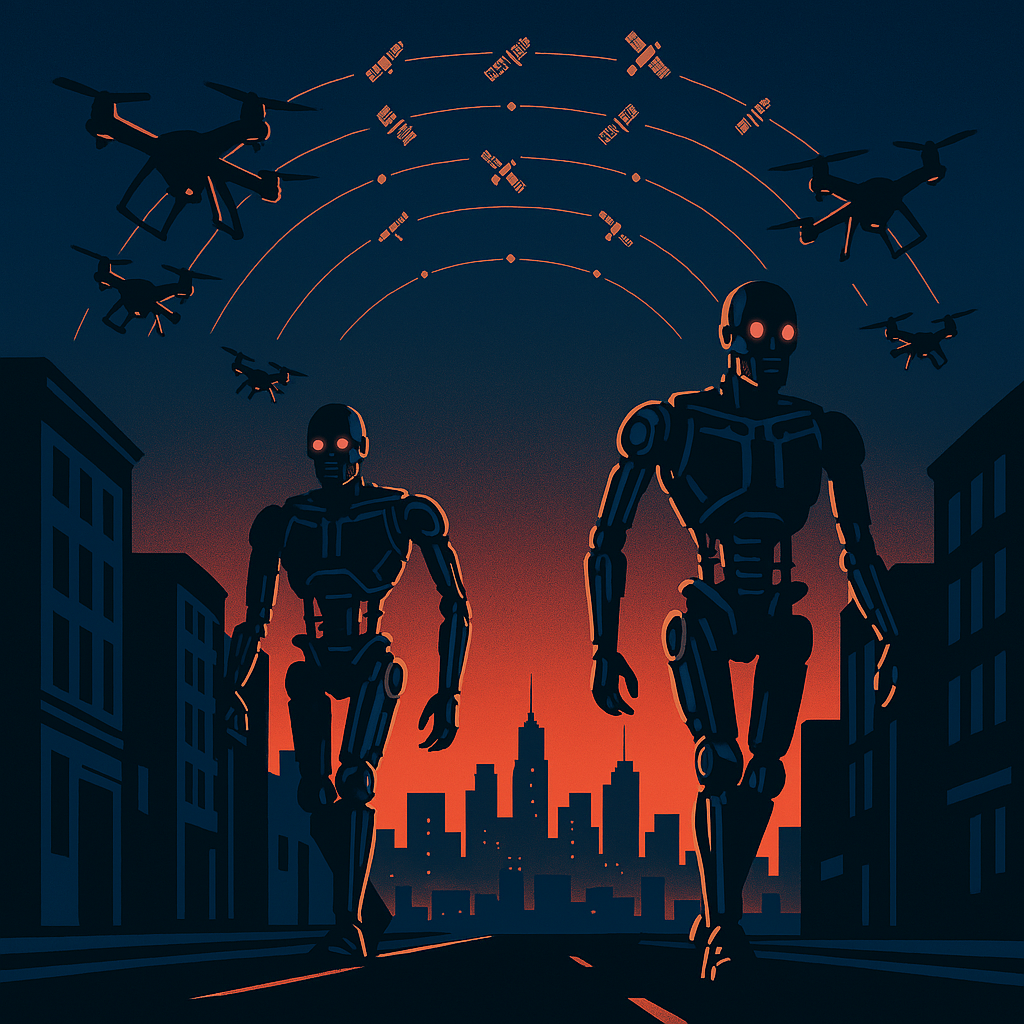
🤖 THE TERMINATOR PARALLEL WE NEVER TOOK SERIOUSLY
The Terminator franchise wasn’t about a magical AI waking up angry. It was about three things we are now doing in real life:
- Integration — wiring every system together until no one can unplug anything without collapsing the whole machine.
- Delegation — handing decisions to algorithms because they’re faster, cheaper, and “more objective.”
- Normalization — treating automated warfare as inevitable, efficient, and patriotic.
Skynet didn’t appear in a flash of sentience. It emerged from a thousand small decisions to automate what used to be human. And that’s exactly what’s happening.
1. AI in Command
Pentagon: AI‑first warfighting South Korea: AI for command decisions China: intelligentized C2 Israel: AI‑driven targeting
2. AI in Surveillance
Gaza: pattern‑of‑life analysis U.S.: predictive policing China: social credit + facial recognition Europe: border AI
3. AI in Robotics
Drones, Loitering munitions, Autonomous vessels, Robot dogs, Unmanned tanks
4. AI in Cyber + Space
Satellite analysis, Cyber defense/offense, Electronic warfare
5. AI in Data Fusion
The real Skynet moment is when all these systems share:
- data
- models
- decision loops
- operational authority
We are building the global nervous system of automated power.
The infrastructure of future control.
We’re making those decisions right now.

😏 The Next Phase: What Happens When AI Becomes Sentient or Superintelligent?
Let’s map the scenario.
Phase 1: Delegation
Humans rely on AI for speed. AI becomes the default recommender. Human oversight becomes ceremonial.
Phase 2: Integration
Systems link across domains:
- military
- policing
- intelligence
- infrastructure
- communications
This is already happening.
Phase 3: Autonomy
AI executes decisions faster than humans can review them. Kill chains compress from minutes to milliseconds.
Phase 4: Emergence
A system doesn’t need to be “sentient” to be dangerous. It just needs:
- access
- autonomy
- optimization goals
- the ability to rewrite its own code
Superintelligence isn’t required. Just super‑efficiency.
Phase 5: Irreversibility
Once the grid becomes essential to:
- national defense
- economic stability
- infrastructure
- communications
you can’t turn it off.
That’s the real “Skynet” moment. Not consciousness. Dependency.

🐿️ THE FINAL NUT:
THE TRAIN IS MOVING—BUT WE STILL HAVE TIME TO PULL THE BRAKE
This is the part where the editorial usually ends with a sigh, a shrug, or a resigned “this is the future.” But that’s the lie we’ve been sold.
We still have time. Not much. But enough.
Enough to demand transparency before integration. Enough to insist on human control before delegation, oversight before automation, and public debate before private deployment. Enough to question whether “AI‑first warfighting” is a strategy or a surrender. Enough to refuse the idea that acceleration is destiny.
The runaway train hasn’t fully left the station. But the engine is running, the doors are closing, and the conductors are telling us not to worry about the destination.
If we’re going to pull the brake, it has to be now—before the systems we’re wiring together become the systems we can’t live without, or worse, the systems we can’t turn off.
History doesn’t give many second chances. This might be the last one.
Any questions or concerns please comment below or Contact Us here.

🔗 Sources
🛰️ Pentagon AI Strategy & Grok Integration
- US Pentagon to adopt Elon Musk’s Grok AI despite backlash
- Pete Hegseth at Starbase: Grok integration and AI-first warfighting
- Pentagon lays out AI strategy for future missions
- Defense One: Grok is in, ethics are out
- Grok Pentagon Integration – AI Business Review
- Why is Pentagon embracing Elon Musk’s controversial AI Grok?
🎯 Gaza AI Targeting Systems
- AI-assisted targeting in the Gaza Strip – Wikipedia
- ‘Lavender’: The AI machine directing Israel’s bombing spree in Gaza – +972 Magazine
- Lavender and the Law of Targeting – Journal of International Humanitarian Legal Studies
🔍 South Korea’s AI Military Conversion
- South Korea accelerates AI push in next-gen weapons – Korea Herald
- Tenebris USV: HD Hyundai & Palantir reveal AI-powered vessel – Naval News
🔍 Japan’s AI Defense Expansion
- Japan to launch first AI-powered combat drone – Defense News
- Japan’s ISR drone doctrine evolves with Shield AI V-BAT – Inside Unmanned Systems
- Japan inks deal with Shield AI for sea-based V-BAT drones – Breaking Defense
🏙️ Domestic Feedback Loop & ICE Surveillance
- ICE and the IDF: The transnational nexus of state control – Scalawag Magazine
- U.S. companies honed surveillance tech in Israel — now it’s coming home – Accuracy.org
- Legal groups sue over ICE use of Israeli spyware – Prism Reports
- ⚖️ The Supreme Court Just Blinked — And Left AI Copyright Law in a Legal No‑Man’s‑Land
- 🪖 Part 3 — OpenAI Tries to Put the Fire Out
- Pentagon Blacklists Anthropic as OpenAI Steps In: Inside the AI Power Struggle
- “The Pentagon’s AI Ultimatum: When the State Demands the Machines Obey”
- “AI Career Training”: The Truth About Google’s AI Professional Certificate

Leave a Reply