
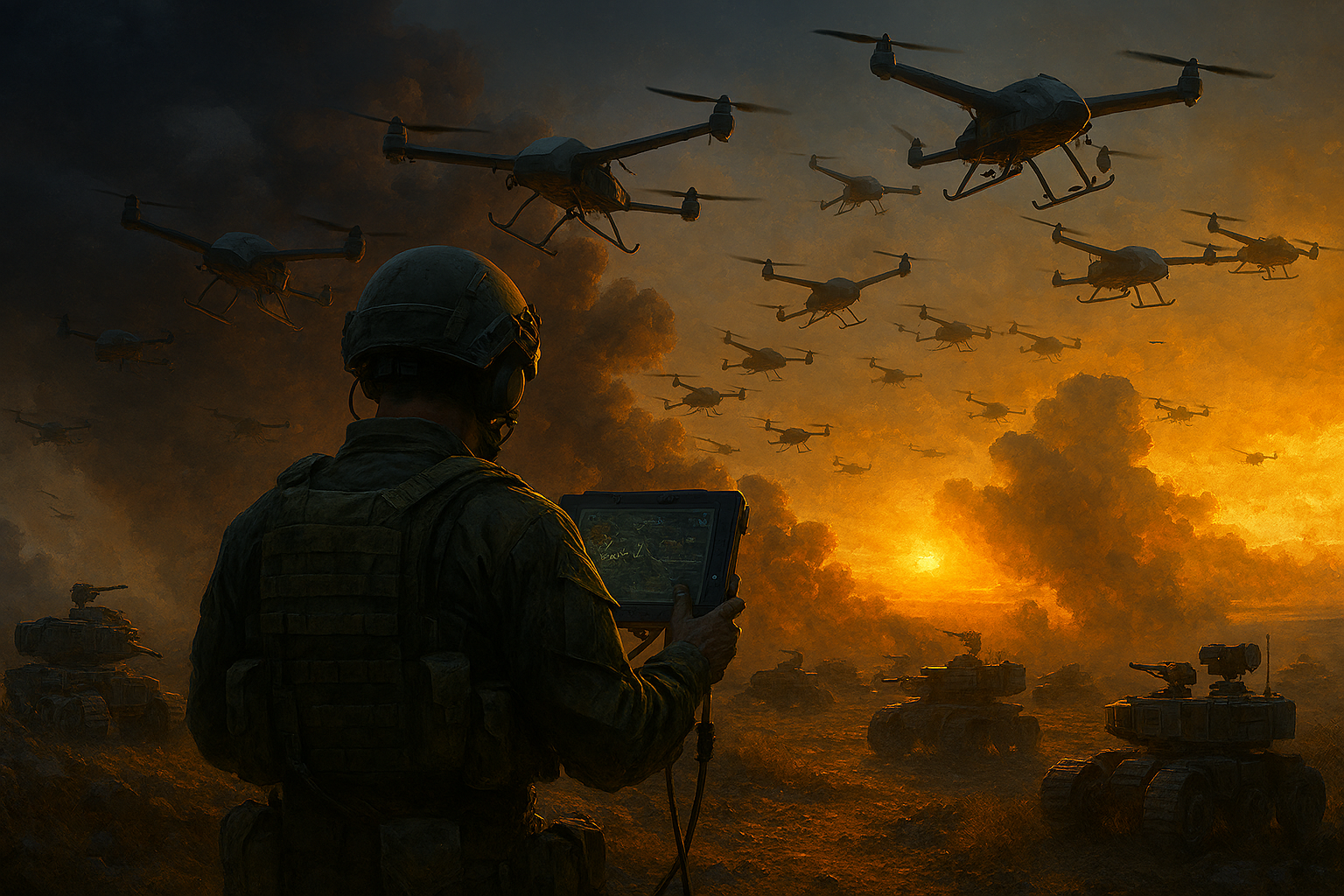
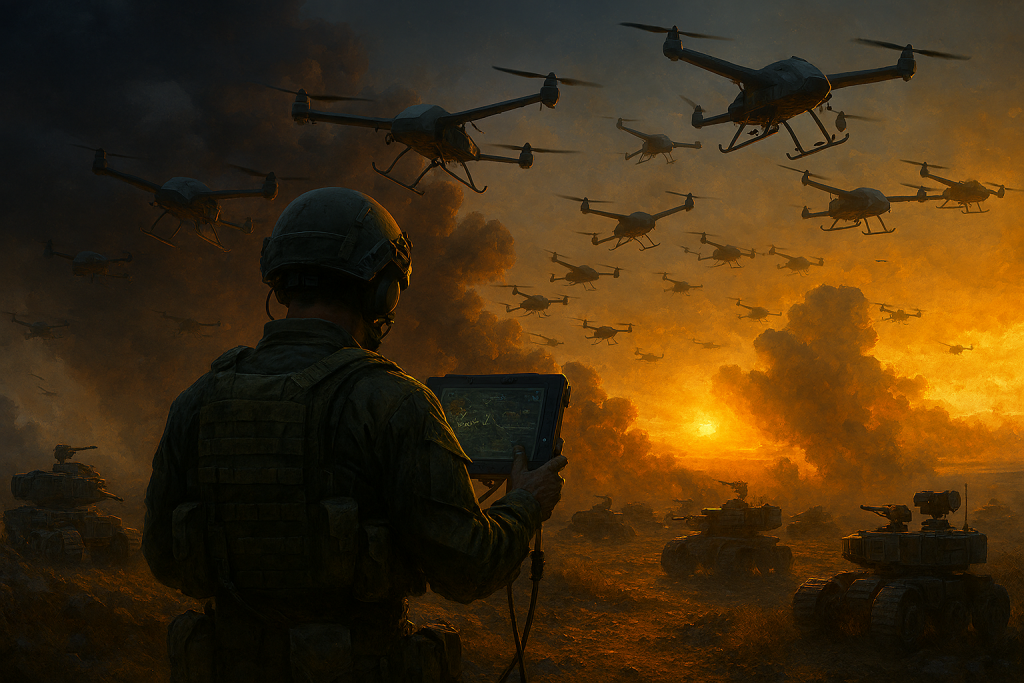
Ukraine’s Ark Robotics has become emblematic of the next phase of warfare. Its CEO, known publicly only as Achi, argues that the old model—one pilot per drone—is unsustainable. Manufacturing can scale faster than human training, so the only way to achieve “total drone warfare” is to flip the paradigm: one soldier commanding dozens, even hundreds, of autonomous units at once.
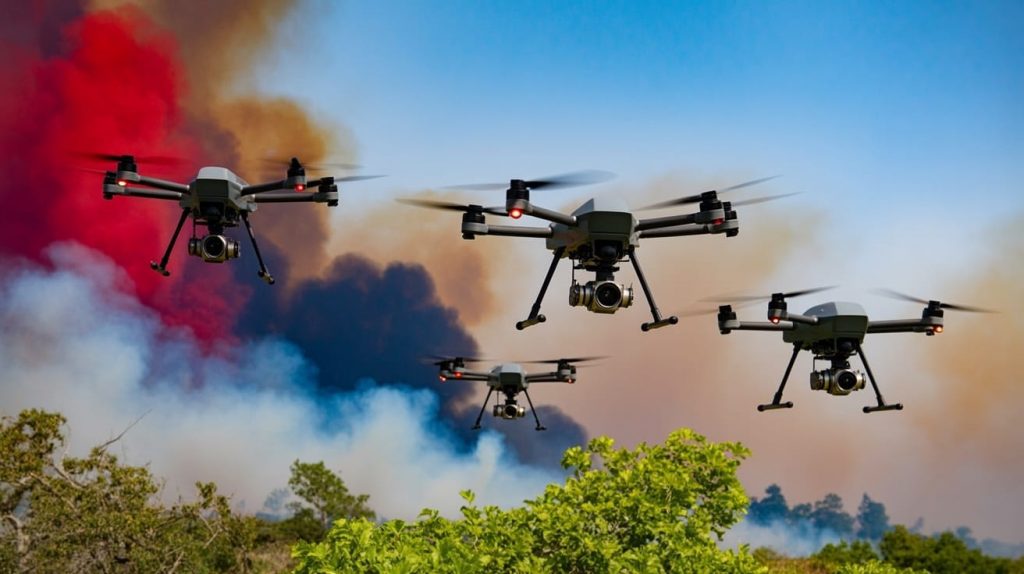
The Spark: Ark Robotics and the Frontier of Autonomy
Ark’s prototype system, Frontier, is designed to coordinate thousands of aerial drones and ground robots with minimal human oversight. Already, Ark claims its robots are deployed across more than 20 brigades. The vision is clear: autonomy as force multiplier, autonomy as survival strategy.
Ark positions itself as an autonomy “infrastructure layer” for mass robotics—mission planning, fleet control, encrypted comms, and cross‑platform integration for air, ground, and maritime systems. Their pitch is mission‑level autonomy, not just vehicle‑level; think networked robots executing synchronized tasks across a shared map with human‑on‑the‑loop oversight.
- Core products: Frontier-style mission OS, multi‑robot command-and-control, secure comms, and a family of portable ground robots.
- Operational claims: From single units to coordinated fleets; system‑agnostic integration; remote operation over long distances; battlefield mapping and target sync.
- Deployment narrative: Government procurement, battlefield trials, and showcase demos emphasizing control from far outside the fight.
- Positioning: “Protecting human lives” by removing operators from danger while scaling autonomy.
Founded in 2024, Ark Robotics is a Ukrainian–Estonian defense startup that has rapidly become a leader in autonomous battlefield systems. Its flagship project, Frontier, is designed to let one operator command thousands of aerial drones and ground robots with minimal oversight.
- Partners: Ark works with the Ukrainian Ministry of Defense, the Ministry of Digital Transformation, and the United24 defense tech cluster, among others.
- Deployment: Ark claims its robots are already used by more than 20 brigades of Ukraine’s Defense Forces.
- Demonstrations: At DALO EXPO 2025 in Denmark, Ark showcased remote control of a ground robot from 2,000 km away, proving long-range encrypted fleet management.
CEO Achi told Business Insider that “total drone warfare” requires flipping the paradigm: one soldier commanding dozens, even hundreds, of autonomous units. Sweden’s defense minister echoed this, saying his country is racing to develop swarm control tech for up to 100 drones
But this is not just about Ukraine. Sweden’s defense minister has publicly acknowledged his country is racing to develop swarm control tech, aiming for one soldier to command up to 100 drones. NATO members are watching closely, even if alliance‑wide investment remains fragmented.
The Laboratory of War: Gaza and Ukraine
Warfare has always been a testing ground for new technologies. In Gaza, reports describe Israel’s use of AI systems to accelerate target generation, track phones, and identify individuals. These systems dramatically increase strike tempo, raising concerns about civilian harm and accountability.
Israel has already demonstrated how autonomy accelerates war tempo. In Gaza, the IDF deployed AI systems like “The Gospel” and “Lavender” to generate bombing targets and identify individuals for assassination. These systems can produce hundreds of targets in days, compared to months of human analysis.
The Times of Israel reported that the IDF even deployed drone swarms in Gaza in 2021, calling it the world’s “first AI war”.
Meanwhile, Ukraine faces the largest drone war in history, with Russia saturating the battlefield with kamikaze UAVs and loitering munitions. Ark’s push toward swarms is a direct response: autonomy as a way to counter mass with mass
In Ukraine, Russia’s invasion has unleashed the largest drone war in history. Kamikaze drones, reconnaissance UAVs, and loitering munitions saturate the battlefield. Ark’s push toward swarms is a direct response to Russia’s sheer numbers: autonomy as a way to counter mass with mass.
The lesson is stark: once autonomy is normalized in combat, the same stack of surveillance, tracking, and predictive analytics migrates into policing, border control, and domestic security. War zones become laboratories; societies become deployment sites.
War as the proving ground, society as the deployment
From battlefield autonomy to domestic control
- War labs: Conflicts accelerate unmanned systems—cheap sensors, mesh networks, onboard inference, and swarm coordination—because battlefield feedback outpaces peacetime procurement.
- Civil flow‑through: The same stack (persistent video, acoustic signatures, RF mapping, phone-based geolocation, and AI triage) shows up downstream in border control, public safety, and “situational awareness” platforms, often justified by cost savings and officer safety.
- Convergence risk: When body cams, city cameras, drones, and predictive models are integrated under a common command layer, the result is a three‑dimensional, continuous surveillance envelope. “Human‑on‑the‑loop” can become rubber‑stamp oversight.
Gaza and the AI target factory (and why it matters beyond war)
- AI in targeting: Reports describe AI‑assisted systems proposing structures, identifying individuals, and tracking phones—accelerating target generation and strike tempo. The disputed details matter less than the shift: human decision-paced warfare becomes machine‑accelerated.
- Norm cascade: Once “acceptable” in war, the logic (scale, speed, and tolerance for error) migrates into policing and border contexts where legal thresholds are—on paper—stricter, but operational pressures push automation forward.
- Accountability gap: If models misclassify 1 in 10 in combat, what error rate becomes “acceptable” over a city? Who audits the datasets, retraining, and the inevitable drift?
The Civil Society Cliff: From Battlefield to City Streets
Once autonomy is normalized in combat, the same stack of surveillance, tracking, and predictive analytics migrates into policing, border control, and domestic security. Drones, AI vision, and predictive policing are already being piloted in Western cities. Integration of body cams, drones, and analytics creates a continuous surveillance envelope.
- Borders: Europe is building a “drone wall” to counter Russian UAVs, integrating sensors, interceptors, and swarm defenses.
- Cities: Western police forces are piloting AI facial recognition vans and predictive policing algorithms, despite documented racial bias in UK trials.
- China: AI patrol cars already roam cities, scanning faces and plates 24/7
The convergence is already visible:
- Borders: “Smart fences” integrate drones, towers, and AI alerting to gatekeep movement. Vendors pitch real‑time interdictions as efficiency gains.
- Policing: Body cams, drones, and predictive analytics are bundled into “situational awareness platforms.” Without guardrails, these systems create a continuous surveillance envelope.
- Procurement reality: Piecemeal buys later “integrate” into de facto platforms. Oversight lags because capabilities are bundled as “features,” not policy changes.
The failure modes are predictable:
- Scale without consent: Citywide drone networks normalized through pilot programs and emergency powers, then made permanent.
- Opacity by design: Proprietary models, training data in black boxes, and “security” exceptions that thwart independent audits.
- Threshold creep: Risk scores and alerts become cause for stops, raids, or denial of services—without court-tested standards.
- Automation bias: Humans defer to the dashboard under stress; appeals become performative when logs are incomplete or sealed.
- Distributed impunity: Responsibility diffuses across contractors, agencies, and algorithms—no single node is accountable.
Pop Culture Warnings: Fiction as Policy Preview
Hollywood has been warning us for decades. Terminator dramatized autonomous killing machines. Minority Report envisioned predictive policing. Elysium showed drones enforcing social stratification. Gattaca warned of algorithmic gatekeeping.
These weren’t just dystopian fantasies—they were rehearsals. The cautionary tales are now policy previews.
The Seduction of Scale
The seduction is simple: autonomy promises scale. One soldier commanding a hundred drones sounds efficient, even heroic. But efficiency is not neutral. It accelerates tempo, reduces deliberation, and normalizes machine judgment.
The rhetoric of “protecting human lives” masks the deeper truth: autonomy shifts the locus of control from human conscience to machine logic. Once embedded, it rarely rolls back. Efficiency is not neutral; it accelerates tempo, reduces deliberation, and normalizes machine judgment.
What to demand before this gets baked in
- Hard guardrails in law: Ban fully autonomous lethal use; codify human‑in‑the‑loop requirements with documented, reviewable decision logs; prohibit “predictive” enforcement without individualized suspicion.
- Independent audits: Mandatory third‑party audits of models, training data, drift, and error rates; public annual reports with usable appeals.
- Procurement transparency: Publish contracts, capability matrices, integration plans, and data retention policies; community impact assessments before deployment.
- Data governance: Strict minimization, deletion schedules, purpose limitation, and meaningful opt‑out mechanisms where feasible.
- Sunset clauses and pilots: Time‑boxed trials with clear success criteria; automatic shutdown absent affirmative renewal after public review.
- Separation of powers: Keep war tech out of civilian policing unless explicitly authorized by legislatures with rights-centric oversight.
The Final Nut: Slow the Roll
Ukraine’s drone swarm story isn’t just about countering Russia. It’s about setting precedents. If wartime shortcuts become peacetime norms, we risk outsourcing freedom to opaque systems.
Humanity stands at a precarious cliff. The path from battlefield autonomy to civil surveillance is short, well‑paved, and already traveled. If we let wartime automation set peacetime rules, we’re not securing freedom—we’re outsourcing it. The future isn’t Terminator; it’s dashboards deciding what we don’t get to question. Pull the cord now: audit the models, legislate the limits, and make the people—not the platform—the operating system of the nation.
The warning is clear we must:
- Audit the models.
- Legislate the limits.
- Demand transparency in procurement.
- Codify human‑in‑the‑loop requirements.
- Sunset emergency deployments.
If we fail to slow the roll, we maybe won’t wake up in Terminator—but we’ll wake up in a dashboard society where opaque systems decide what we don’t get to question.
The choice is ours: keep humans as the operating system of society or let platforms write and enforce the rules.
Any questions or concerns please comment below or Contact Us here.


Extensive Sources List
Ukraine’s Ark Robotics Demos Frontier System: Remote Drone Control from …
Robotics industry insider says the future is one soldier backed by AI controlling swarms of drones
Israel’s Use of AI in Gaza May Be Setting a New Warfare Norm | TIME
https://time.com/7202584/gaza-ukraine-ai-warfare
AI-assisted targeting in the Gaza Strip – Wikipedia
https://en.wikipedia.org/wiki/AI-assisted_targeting_in_the_Gaza_Strip
In apparent world first, IDF deployed drone swarms in Gaza fighting
https://www.timesofisrael.com/in-apparent-world-first-idf-deployed-drone-swarms-in-gaza-fighting
The New Kreuger 100XR Interceptor That Could Boost NATO’s Drone Wall
https://www.newsweek.com/kreuger-100xr-interceptor-could-boost-nato-drone-wall-11194574
November C-UAS News: Guarding the Eastern Flank and Other Maneuvers
Police Admit AI Surveillance Panopticon Still Has Issues With “Some Demographic Groups”
https://futurism.com/artificial-intelligence/police-uk-surveillance-ai
publications.lawschool.cornell.edu
Predictive Policing and the Implications of AI Across Global Frameworks …
International Business Times UK
China’s AI Police Cars Use Facial Recognition in a 24/7 Surveillance Shift for Citizens
China’s censorship and surveillance were already intense. AI is turbocharging those systems
https://www.aol.com/articles/china-censorship-surveillance-were-already-063923166.html
Startup Tests New Controller for Ukraine Drones and Robots – IEEE Spectrum
https://spectrum.ieee.org/ukraine-drones-2671254184
France is two years from fielding drone swarms in its armed forces
Drone Swarms Archives | NATO Science and Technology Organization
https://www.sto.nato.int/document-tag/drone-swarms
Norway Deploys First Operational NATO Drone Swarm As Europe Races To …
Pandemic surveillance – how AI will police the next global health crisis
The West, China, and AI surveillance – Atlantic Council
https://www.atlanticcouncil.org/blogs/geotec
- Deeznuts.tech Developer Progress Update 8-17-2026
- The Truth Behind the U.S. Government’s Sudden Shift on Anthropic
- Google Gives in to Uncle Sam’s Demands
- China Breaks the Brain Barrier with Neuracle BCI Technology
- ⚖️ The Supreme Court Just Blinked — And Left AI Copyright Law in a Legal No‑Man’s‑Land

Leave a Reply