
The Trump administration has unveiled its latest tech gambit: the creation of a U.S. Tech Force, a federal initiative designed to embed Silicon Valley’s best and brightest inside government agencies. On paper, it’s a bold move. In practice, it may be the most ambitious experiment yet in fusing policy with code.
📢 What’s Happening
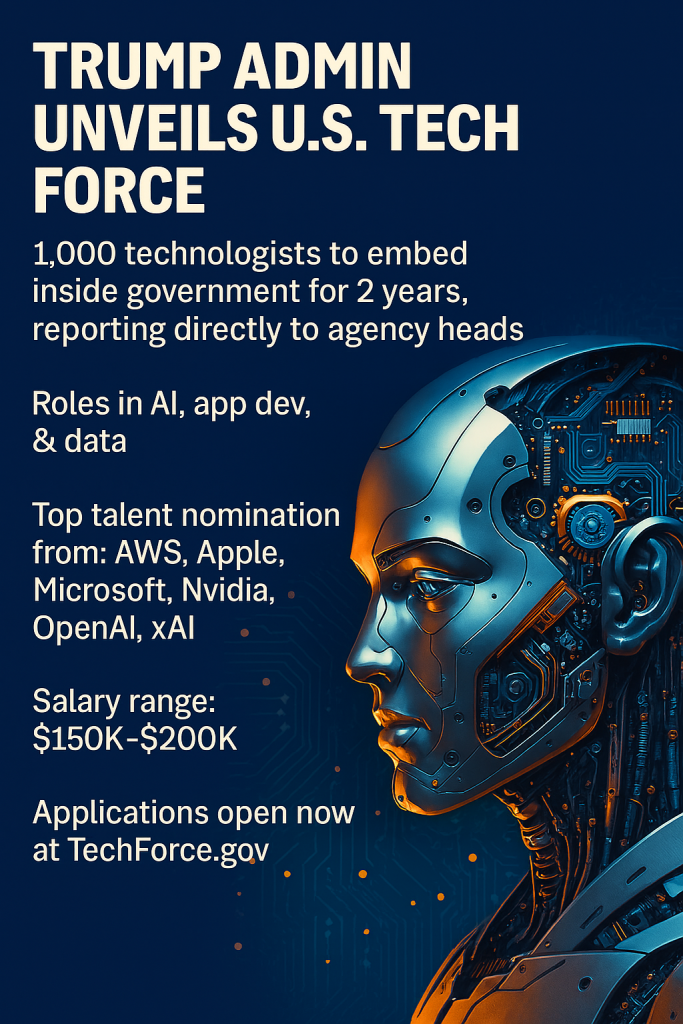
- 1,000 engineers and specialists will be hired for two-year terms inside federal agencies.
- They’ll report directly to agency heads, bypassing mid-level bureaucracy.
- Focus areas: AI, app development, data infrastructure, cybersecurity, and digital modernization.
- Salaries: $150K–$200K annually, rivaling private-sector compensation.
- Private sector partners: AWS, Apple, Microsoft, Nvidia, OpenAI, Meta, Oracle, Palantir, Uber, xAI, Adobe, and more.
- Tech firms can nominate their own staff to serve on rotation.
- After their term, participants are eligible for full-time roles with partner companies.
🔑 Key Official Resources
- OPM Announcement: The U.S. Office of Personnel Management (OPM) formally launched the Tech Force as part of President Trump’s AI Action Plan.
- Application Site: Candidates can apply directly through TechForce.gov.
- Eligibility: Open to software engineers, AI specialists, data scientists, cybersecurity experts, and project managers. A traditional degree is not required; demonstrable technical skills suffice.
- Salary Range: $150,000–$200,000 annually, plus benefits.
- Term Length: Two-year appointments, reporting directly to agency heads.
- Participating Agencies: Departments of Defense, Treasury, State, Labor, Commerce, Energy, Homeland Security, Veterans Affairs, plus IRS, CMS, SBA, OPM, GSA, and more.
- Private Sector Partners: AWS, Apple, Microsoft, Nvidia, OpenAI, Adobe, IBM, Meta, Oracle, Palantir, Uber, xAI, Zoom, and others.
🏛 Agencies in Play
The initiative isn’t confined to one corner of Washington—it’s sprawling across nearly every major department:
- Defense (DoD): AI defense systems, cybersecurity, advanced analytics.
- Treasury: Financial infrastructure modernization, fraud detection.
- State: Digital diplomacy platforms, secure communications.
- Energy: AI-driven grid management, climate modeling.
- Transportation: Traffic optimization, autonomous systems.
- Veterans Affairs: Health data modernization, AI-assisted care.
- IRS & CMS: Tax and healthcare data infrastructure.
- GSA: Government-wide digital services and procurement modernization.
🏛 Agencies Offering Positions
According to OPM and official announcements, positions are spread across more than a dozen agencies:
- Defense Department (DoD): AI for defense systems, cybersecurity, and advanced analytics.
- Treasury Department: Modernizing financial infrastructure and fraud detection.
- State Department: Digital diplomacy platforms and secure communications.
- Energy Department: AI-driven energy grid management and climate modeling.
- Agriculture Department: Smart farming data systems and food supply chain modernization.
- Transportation Department: AI for traffic optimization and autonomous systems.
- Veterans Affairs (VA): Health data modernization and AI-assisted care delivery.
- IRS & CMS: Tax system modernization and healthcare data infrastructure.
- General Services Administration (GSA): Government-wide digital services and procurement modernization
💼 Position Details
- Titles: GS-13 and GS-14 level roles (mid-to-senior technologists).
- Salary Range: $130,000–$195,000 annually.
- Eligibility: No degree required; applicants assessed on technical skills and problem-solving ability.
- Term Length: Two years, reporting directly to agency heads.
- Application Process:
- Submit resume via TechForce.gov or USAJobs.
- Complete technical assessment.
- Interview with agency leaders.
- Background check
📅 Rollout Timeline
- December 15, 2025: Official announcement by OPM and White House.
- Applications Open: TechForce.gov (via OPM).
- Hiring Deadline: March 31, 2026.
- Placement Goal: First cohort embedded by Q1 2026.
- Program Duration: Two years, ending with a career fair linking participants to both federal and private-sector roles.
📌 Important Features of the Plan
- Direct Agency Reporting: Engineers bypass mid-level bureaucracy, reporting straight to agency leadership.
- Talent Rotation: Tech companies can nominate their own staff for temporary government service.
- Post-Term Opportunities: Alumni are eligible for full-time roles with partner tech firms.
- Strategic Aim: Designed to close the federal tech talent gap, modernize infrastructure, and assert U.S. dominance in AI against global competitors.
- Policy Context: Follows Trump’s executive order establishing a national AI policy framework to unify federal AI rules and preempt state-level regulation.
🎯 Why It Matters
This isn’t just a hiring spree—it’s a policy maneuver. Trump’s executive order establishing a national AI policy framework set the stage, and the Tech Force is the talent pipeline to make it real. By embedding engineers inside government, the U.S. isn’t just catching up—it’s attempting to redefine how tech and policy collaborate.
But here’s the tension:
- Best case: A revolving door of innovation, where engineers modernize creaky systems and leave behind lasting infrastructure.
- Worst case: A revolving door of bureaucracy, where talent is wasted in red tape while tech giants reap the recruitment benefits.
🥜The Final Nut
The Tech Force is a smart talent play wrapped in a policy push. It’s also a test of whether Washington can resist turning engineers into paper-pushers. With salaries rivaling the private sector and direct reporting lines to agency heads, the administration is betting big that this won’t be business as usual.
The real question: Who writes the rules when tech and policy collide? If this becomes a pipeline feeding talent back into Big Tech, the public may wonder whether the government is modernizing—or simply subsidizing corporate recruitment.
The U.S. Tech Force could be remembered as the moment Washington finally learned to code—or as another chapter in the saga of bureaucratic overreach dressed up as innovation. Either way, the stakes are clear: the future of AI policy won’t be written in think tanks, but in the code deployed inside federal agencies.
Any questions or concerns please comment below or Contact Us here.


- Deeznuts.tech Developer Progress Update 8-17-2026
- The Truth Behind the U.S. Government’s Sudden Shift on Anthropic
- Google Gives in to Uncle Sam’s Demands
- China Breaks the Brain Barrier with Neuracle BCI Technology
- ⚖️ The Supreme Court Just Blinked — And Left AI Copyright Law in a Legal No‑Man’s‑Land

Leave a Reply